by Ainsley Platt, Arkansas Advocate
April 29, 2026
The Arkansas Legislature adjourned its fiscal session Wednesday, wrapping up three weeks of work that included debate over a multimillion-dollar economic development incentive package and ended with lawmakers rejecting an effort to provide state matching funds for donations to the public television network.
Legislators in both chambers easily approved identical versions of the $6.7 billion state budget, known as the Revenue Stabilization Act, for the fiscal year starting July 1. The House voted 70-27. The Senate voted 32-2.
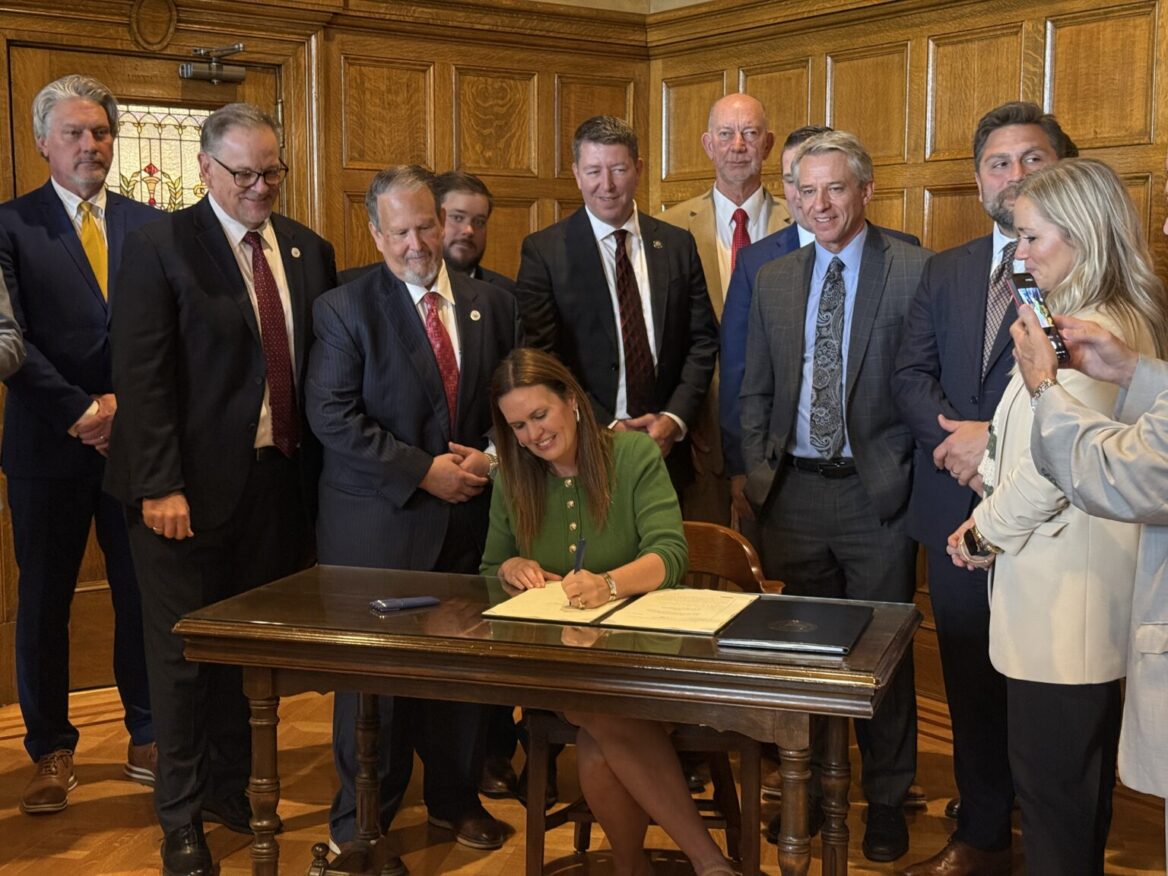
Gov. Sarah Huckabee Sanders signed the budget legislation Wednesday afternoon. The Republican governor applauded the work done by the majority-GOP Legislature, saying the budget followed through on promises she made during her State of the State address while setting up lawmakers to cut income taxes during an expected special session next week.
“We want it (the special session) to be pretty singularly focused on providing relief to Arkansans, letting them keep more of their hard-earned money,” Sanders said.
Budget includes money for vouchers, West Memphis super project
The $6.7 billion budget includes $309 million to fund the state’s school voucher program known as the Educational Freedom Account program, $122 million more than was budgeted last year and matching what the state eventually spent on the program this year.
The vouchers will provide up to $7,208 next school year to participating students for private school tuition and homeschooling expenses. More than 44,000 students received funds through the voucher program during the 2025-2026 school year.
The budget also allows for a transfer of up to $300 million in state surplus funds into an economic development incentive fund, which generated substantial debate in the House on Monday.
The money is aimed at attracting an advanced manufacturing project to West Memphis, possibly creating thousands of jobs. While the budget says the prospective project is a “non-data center,” legislative leaders and the governor have been otherwise tight-lipped about the industry involved and the states Arkansas is competing against to land the project.
Republican Sens. Bryan King of Green Forest and Clint Penzo of Springdale voted against the budget. King told the Senate he took issue with the budget giving local governments fewer state funds to maintain their water, sewer and road infrastructure.
Several towns and cities have gone without those funds for months because they fell behind on filing required audits of their water and sewer systems. Senators rejected an effort by King to introduce legislation that would have directed more of that money, known as turnback funds, to counties.
King said both municipal and county governments have also been facing higher expenses since the COVID-19 pandemic in 2020.
“When you see these county governments struggling to make it and making cuts, just remember, go back and take responsibility and tell them, ‘We are giving you far less money to work with than we did in years past,’” King said.
Arkansas TV matching funds bill fails
Before adjourning, the House twice rejected Senate Bill 77, which would have given the state the option to match up to $550,000 in private donations to the state’s public television station.
The legislation did not provide the money for the matching funds, and supporters said the source of the state funds would have to be determined later.
The measure, authored by Democratic Sen. Clarke Tucker of Little Rock and overwhelmingly approved by the Senate Monday, attracted more debate than most bills on the House floor during the fiscal session.
Opponents noted that the network’s leadership hadn’t asked for the funding, while supporters pointed to how the funds could be used for any reason and weren’t required to be used for PBS membership dues.
It comes as Arkansas TV, formerly known as Arkansas PBS, has paused its first-in-the-nation plan to cut ties with PBS after public outcry. The House rejected the bill Wednesday as former first ladies Gay White and Barbara Pryor, who lead a group rallying to keep PBS in the state, watched on from the gallery.
The station’s governing board voted to disaffiliate after federal funding cuts to the Corporation for Public Broadcasting last year. Arkansas TV CEO Carlton Wing said the funding cuts made continued membership with PBS economically unfeasible.
Funding the public television network in general has been a consistent source of angst in the House in recent years, and the network’s budget bill took multiple votes before it was approved in the House Tuesday.
Opponents of public television have said the state doesn’t need to spend money on PBS programming when Arkansans can stream that programming online. Republican Rep. Carol Dalby of Texarkana speaks in favor of an appropriations bill to provide state matching funds for some donations to Arkansas TV during floor debate in the Arkansas House of Representatives on Wednesday, April 29, 2026. (Photo by Ainsley Platt/Arkansas Advocate)
But Texarkana Republican Rep. Carol Dalby, who spoke in favor of the matching funds measure Wednesday, said that wasn’t always true for people living in remote areas of Arkansas.
“I know that in my area, you can’t get streaming,” Dalby said. “You live in the outskirts of Miller County, you’re gonna have a hard time getting this station on your computer. They can get it on TV, because they will have cable, and they can watch it that way.”
Tucker, the lead sponsor, expressed disappointment in the outcome, saying it was sad that politics got in the way of “providing a valuable and free educational resource for the people of Arkansas, especially our kids.”
“But we will have more opportunities for support during the interim, and we will not stop working until all Arkansans can still access the PBS content that has been so meaningful for countless Arkansans from every corner of the state,” he said.
Reporter Tess Vrbin contributed to this article.
- 3:15 pm This story was updated to include more reporting, and to reflect that the governor signed the state budget act
Arkansas Advocate is part of States Newsroom, a nonprofit news network supported by grants and a coalition of donors as a 501c(3) public charity. Arkansas Advocate maintains editorial independence. Contact Editor Andrew DeMillo for questions: info@arkansasadvocate.com.