
If we have said it once, we have said it a thousand times: “Economic Development ruled the day during the 2025 Regular Legislative Session– while the Arkansas Economic Development Commissioni presented itself as the agency that knows how to win!”
Recently, AEDC Executive Director Clint O’Neal spent much of the May 20th Joint State Agencies Committee meeting in Jonesboro walking lawmakers through those wins: steel plants, food processors, aerospace contractors, billions in new investment, as well as a state climbing the rankings. But when the conversation turned to data centers (the industry generating the most public angst in Arkansas right now as well as being the one backed by real public money), O’Neal’s answers sounded different.
When asked directly by State Rep. Jimmy Gazaway (R – Paragould), an attorney and representing HD31, what these companies have told AEDC about the purposes of the data centers, O’Neal didn’t have much to offer, stating, “The conversations I’ve been a part of we’re really not getting— have not received that level of detail.” (00:46:36)

O’Neal explained that data centers are handled differently than the manufacturing and industrial projects AEDC normally recruits — being the projects where the agency negotiates terms, weighs infrastructure costs, and decides how much public incentive it takes to win.
Data centers, by contrast, operate under a separate statutory tax exemption, passed in 2023 and since amended. By O’Neal’s own description, AEDC’s role is limited to checking eligibility and confirming a “positive cost-benefit analysis”- not negotiating, not pressing companies on their plans, and not asking the questions it would normally ask before public money is on the line. “The transparency, on us continuing to ask questions, is not there in the same way that it may be in other projects,” he told the committee. (00:48:01)
That’s not a small admission. These tax exemptions, and the property tax abatements that often come with them, represent real tax revenue, as some Arkansas communities are abating up to 65% of property taxes otherwise owed by these companies for a period of 30 years under an Economic Development program called Act 9.
Taxpayers must understand that when tax exemptions and abatements are granted to one company, other taxpayers pick up the tab for the government resources the tax-exempt company enjoys.
Tax-exempt companies continue to use government resources, the payment for which they are excluded. This means that state and local governments are choosing to collect more taxes from other taxpayers, in exchange for funding projects the agency overseeing them admits it doesn’t fully understand.
In short, Arkansans across the state are being asked to foot the bill, in the form of tax increasesii, for an industry the state’s own economic development director can’t explain.
Rep. Gazaway returned to the point later in the meeting, framing it as a question he’s hearing from far more than just his own constituents. “I guess I just wondered in the course of your conversations if, you know, you’ve been able to pull the curtain back a little bit and understand the mystery as to what exactly they’re doing with these data centers,” he said, “because that seems to be a question that’s asked by a lot of people that doesn’t seem to have gotten a very clear answer.” (00:48:11)
That gap in information landed hardest for State Rep. Denise Ennett (D-Little Rock), who represents District 80 and has two data center projects coming into her community. Rep. Ennett told the committee she’s been fielding constituent questions she can’t answer. “I have more questions than answers to give to my constituents, moving forward,” she said. (00:35:46)
Later, pressing O’Neal on whether the department could help explain these projects to the public, she added: “I get beat up a lot about these data centers. Forgive me if I’m not just happy-go-lucky about it, because I don’t get all the answers, and I get all the questions.” (00:37:35)
Rep. Ennett also pressed O’Neal on whether companies could simply talk to the communities they’re moving into. O’Neal pointed to Google’s purchase of land at the Port of Little Rock as an example of a company that hasn’t made a final commitment, and said that, typically, the first real public notice a community gets is the announcement that a deal is done. “Typically, the first public notice is the full commitment,” he said. (00:36:32) Community “conversations,” in his telling, happen to educate residents after the company has already decided to move forward, not before.
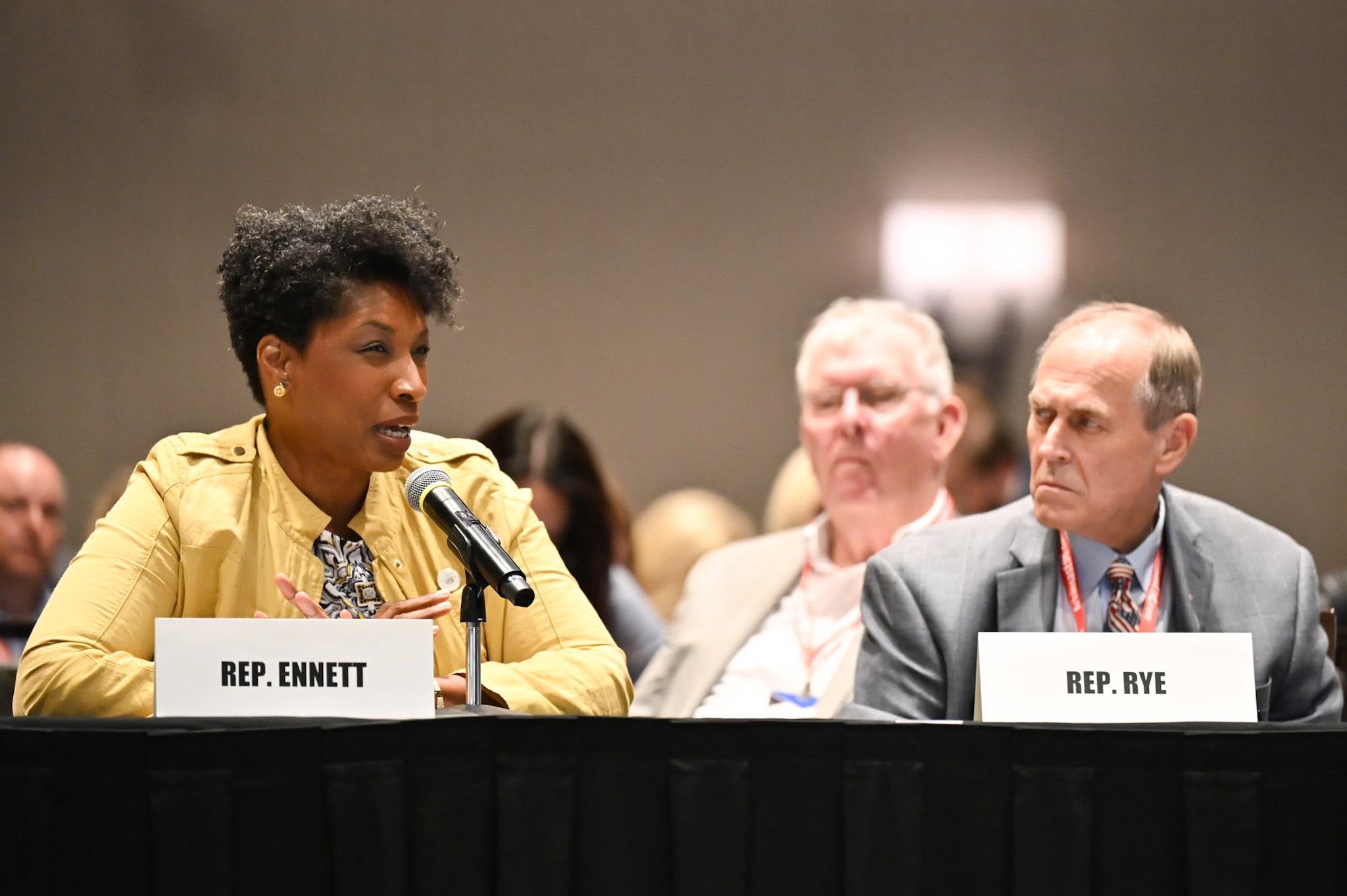
When Rep. Ennett asked whether AEDC itself could produce something — an ad, a public information campaign — to help explain what these companies are and what they’re doing, O’Neal said the agency would “certainly look at it,” but suggested it might be better handled by the companies themselves or by the utilities.
On the question of NDAsiii shielding incentive negotiations from public scrutiny, O’Neal was direct: “100% transparent once the deal is done, but in the middle of the deal, that would certainly kill the deal.” (01:06:12)
This exchange between our duly elected officials, whose job is to look after taxpayer money, leaves Arkansas taxpayers in an odd position. The agency that administers the incentives says it doesn’t have access or the obligation to ask data center companies what they’re building or why. The companies, per O’Neal, generally don’t talk to communities until after the deal is final. And the elected officials closest to the affected districts, like Rep. Ennett, are left without the information their constituents are asking for, because the people who might have it say it isn’t really their job to find out.
Meanwhile, the tax breaks (a/k/a tax increases for those not receiving them) keep flowing.
To listen to the May 20 meeting in its entirety, click here.
i AEDC operates under the umbrella of the Arkansas Department of Commerce.
http://www.arkansasaedc.com
https://encyclopediaofarkansas.net/entries/arkansas-economic-development-commission-424/
ii Explain how tax incentives and savings for some groups are tax increases for others:
Tax incentives and targeted savings reduce revenue, forcing governments to either cut public services or raise rates elsewhere to balance budgets. Consequently, the financial burden shifts. A lower tax bill for one group directly requires a higher tax burden on others to maintain equivalent overall tax collections. This dynamic operates through several core economic and structural mechanisms:
- The Zero-Sum Nature of Revenue: Because government budgets generally must balance, every dollar of revenue lost to exemptions (like deductions or credits) requires an extra dollar of revenue from non-exempt taxpayers or a reduction in public services.
- Broadening the Tax Base: To offset revenue lost from targeted incentives, governments often eliminate other deductions or raise statutory rates. Taxpayers who do not qualify for the incentives are left paying higher effective rates on a broader base of taxable income.
- Shift to Consumption and Regressive Taxes: If income tax revenues shrink due to targeted exemptions, governments frequently increase consumption taxes (such as sales or value-added taxes). Because lower-income groups spend a larger percentage of their earnings on goods and services, this shifts the tax burden downward.
- Reduced Public Investment: When savings for specific groups result in underfunded budgets, public goods—such as infrastructure, education, and healthcare—deteriorate. This effectively acts as a stealth tax increase, forcing wealthier and middle-class families to pay out-of-pocket for private alternatives.
iii NDA—a legal and binding contract–non-disclosure agreements. These are also known as a confidentiality agreement, between two or more parties. It ensures that sensitive information—such as trade secrets, business plans, or intellectual property—remains private and is not shared with unauthorized individuals or competitors.