

Author’s Note / Disclaimer:
This article describes a procedural vulnerability in how early voting is conducted in many Arkansas counties. It is written solely to highlight risks that currently exist and to urge concrete reforms before the next election.
I am not encouraging or endorsing any illegal activity. I have never engaged in vote tampering or election fraud of any kind, and I strongly condemn it. The detailed description herein is necessary to demonstrate how accessible the vulnerability is under current practices; without that clarity, the scale of the risk remains abstract and easy to dismiss.
The vast majority of election officials, commissioners, clerks, and poll workers in Arkansas are honest people doing difficult, underpaid work under complex rules. The problems described here are primarily systemic – the product of inadequate physical security standards, inconsistent chain-of-custody practices, low compensation, high turnover, and limited oversight – not the result of widespread personal corruption. Individual counties and individual officials vary widely in their diligence.
My goal is to make the case that Arkansas can and should adopt stronger, more consistent safeguards, to protect the integrity of every honest vote and reduce the opportunity for anyone who might seek to exploit their trusted position.
I publish this in the hope that the Arkansas Legislature will take action to protect the democratic process in Arkansas before November.
Article:
Election integrity has been debated for as long as elections have existed, but the conversation intensified dramatically after November 2020. The core assumption underlying much of that debate is simple: if a person can cheat to win power, many will – because the stakes are extraordinarily high.
A century ago, the vulnerabilities were overt: publicly signed ballots, poll taxes, employer and landlord intimidation, and stories of ballot boxes dumped in rivers or stolen at gunpoint by militias. With the shift to machine voting, attention turned almost exclusively to cyber attacks and remote hacking. While experts acknowledge that a successful hack could swing 100% of votes in a targeted area, many remain skeptical that it has happened at scale. Hacking, after all, requires specialized technical skills and carries significant risk of detection.
But what if the “hacking” angle is largely a smokescreen? What if stealing the election were easy? What if one motivated person could do it, by himself, with no special technical expertise whatsoever?
I call this the “Early Vote Replacement” method. It has two variants: the “Insider” variant, and the “Outsider” variant. As you read the steps below, ask yourself honestly: Could you carry this out in your county? And even if you couldn’t, is there anyone in your county who could?
Here are a few pieces of background information to help you understand:
- Between 40% and 60% of ballots in a typical Arkansas election are cast during the early voting period.
- Most competitive races are decided by margins of 15% or less.
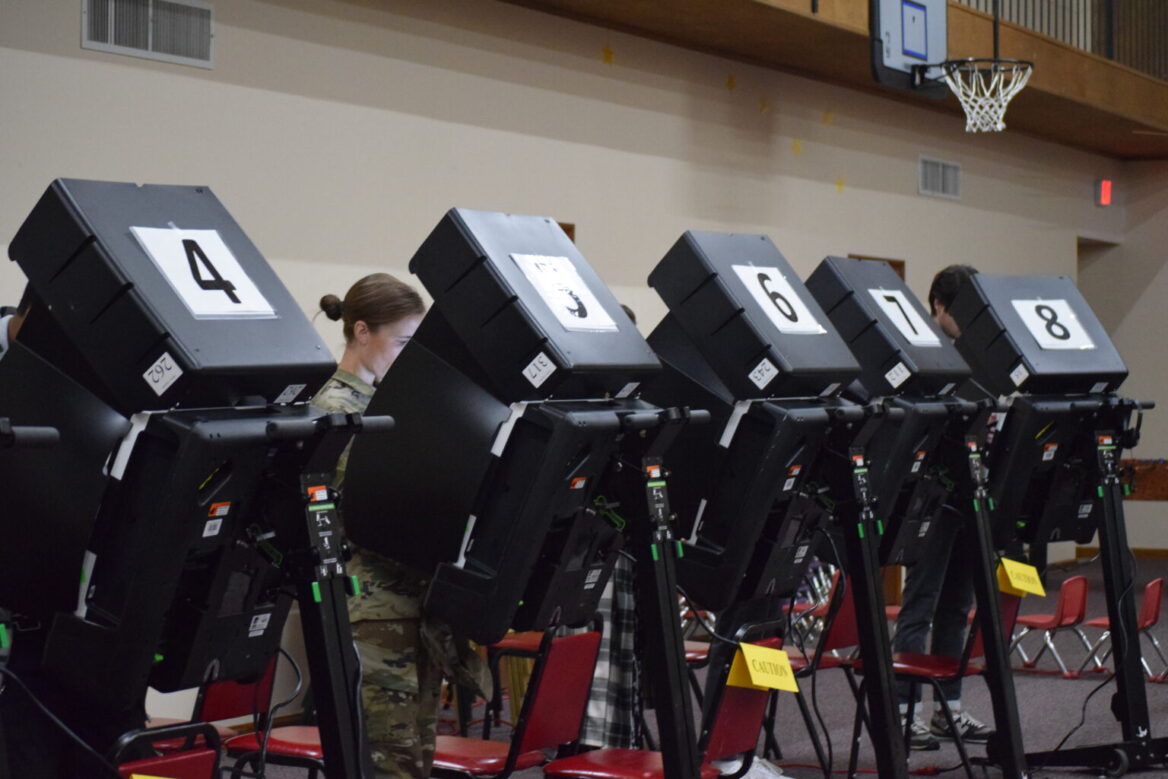
- Ballot marking devices (usually ExpressVote) and tabulators (usually DS200) are routinely stored together overnight at early voting sites for up to two weeks.
- Blank ExpressVote ballot stock and the physical keys to voting machines are functionally identical across all machines, counties, and elections in the state. The paper has no serial numbers or security features – a blank sheet from 2016 is indistinguishable from a blank sheet in 2026.
- ExpressVote machines can generate ballots independently, without reference to the poll book.
The above facts are common knowledge in the industry.
And now, here is your step-by-step guide for stealing a county’s elections in Arkansas:
How to Steal an Arkansas Election: “OUTSIDER” Variant
Supplies List
- A Key to the Early Voting Location
- Keys to the DS200 (or other tabulating) device
- Blank ExpressVote ballot stock
- A sewing pin
- A trash bag
- Knowledge of the machine codes (election passwords) for the current election cycle
Instructions
- Access the Early Voting location when no one else is present. This can be overnight, on a Sunday, or during any other low-traffic period. Replacing ballots at the end of the first week of early voting lets you affect roughly 25% of all ballots for that election — often enough to swing close races. Waiting until the final days lets you affect nearly half of all votes.
- Go to the tabulator and unlock the panel covering the USB drive/memory card area. Select “Close Poll” and print a results tape. This tape shows the current number of ballots cast per precinct.
- Take the results tape and your blank ballot stock to a Ballot Marking Device (ExpressVote). Generate replacement ballots with the desired vote selections, matching the exact number of ballots per precinct shown on the results tape.
- Return to the DS200. Use your sewing pin to open any numbered zip ties securing the ballot storage compartment and set them aside. (Note: Some machines have no zip ties. If one breaks, it can later be dismissed as human error or equipment failure, and discarded along with any attached chain-of-custody paperwork.)
- Unlock the compartment, remove the voted ballots, and place them in the trash bag for later disposal.
- Re-lock the ballot storage compartment and re-attach the numbered zip ties. Instruct the machine to reopen the poll. When prompted, enter the election code to clear the existing vote totals and reset the machine.
- Feed your replacement ballots into the tabulator.
- When finished, turn off the lights, lock the building, and remove the bag of original ballots.
Follow-up Questions and Answers:
After reading the instructions above, several practical questions naturally arise: Who has access to the necessary keys and materials? How difficult is it to obtain the election codes? What about security cameras? And can this kind of manipulation be detected afterward?
Access to Keys, Ballot Stock, and Codes
Physical keys to tabulators and blank ballot stock are universal across all machines, counties, and elections in Arkansas. Access typically includes:
- Current Election Commissioners, Coordinators, County Clerks, Deputy Clerks, and Poll Supervisors.
- Former holders of those positions (many retain keys for years).
- Courthouse employees and their acquaintances.
- In some cases, locksmiths or state-level election staff.
Election codes (passwords) are known to insiders responsible for running the election. They are also entered repeatedly during mandatory Logic & Accuracy (L&A) testing, which is often done with help from poll workers and other staff, and is open to the public. Anyone who participates in L&A testing will almost inevitably learn the codes. It is also likely that the State Board of Election Commissioners and Secretary of State’s office staff can obtain them directly from ES&S.
The chart below summarizes who can realistically obtain the required items:
| Item: | Building Key | Machine Keys | Blank Ballot Stock | Election Codes | Trash Bag and Pin |
| Who Can Get It | Current/former courthouse employees and their contacts; locksmiths | Current/former election staff (Commissioners, Coordinators, Clerks, Deputies, Poll Supervisors) from any county; their contacts | Current/former election staff in any county; anyone with access to storage or ES&S ordering in any county; their contacts | Election insiders; L&A testing participants; state-level staff; potentially members of the public who observe L&A testing | Everyone |
In total, dozens to hundreds of people per county likely have enough access to enable the Outsider variant.
Example Scenario
A former Deputy Clerk still possesses courthouse and machine keys, and brought home a box of ballot stock when she stopped officially working elections four years ago. She offers to help with L&A testing in her county. She learns the codes and performs a ballot replacement overnight during the first week of early voting to assist a friend running for local office.
Cameras, Human Monitoring, and Detection
Security cameras at Early Voting sites – which are not (to my knowledge) used routinely in any county – do not significantly deter this method unless they are monitored live 24/7. Someone with building access can usually disable them or cut power (the DS200 runs for hours on battery backup). Gaps in footage are typically attributed to “human error” or technical failure and do not prove wrongdoing.
Posting live human security guards at Early Voting locations overnight is one of the more effective deterrents, as it raises the minimum number of conspirators required and increases the chance of direct observation. However, two guards for two weeks of early voting would add roughly $8,000 to $20,000 in costs per location – in some smaller counties, the equivalent of a 10-20% increase in the annual election budget for a single Early Voting location.
Post-event detection is also difficult. The primary record of suspicious activity would appear in the DS200’s event logs (e.g., poll closes, vote clears, or unusual access during early voting). However, most counties do not routinely review these logs. They are lengthy and cumbersome, and – importantly – they can be exported to Excel and edited by anyone with basic spreadsheet skills before being released in response to a FOIA request. It is also possible to set the DS200 clock, so that fraudulent votes appear to have been cast during regular voting hours. A “vote totals cleared” entry during early voting is suspicious but not conclusive proof of cheating.
How to Steal an Arkansas Election: “INSIDER” Variant
The Insider variant is even simpler – and far less detectable.
An “insider” is here defined as someone who is officially authorized to have access to the materials listed above for the “Outsider” Variant of “Early Vote Replacement,” and who also has access to the electronic pollbook, and the storage facility where additional tabulators and ExpressVotes are stored. In other words, an election “insider” is one of the people actually responsible for running the current election.
Supplies List
- Key to the Early Voting location
- Key to the election equipment storage room
- Election codes (passwords)
- Spare Early Voting flash drive
- Access to the ExpressPoll (electronic pollbook)
- A truck or van (if Early Voting and storage are in separate locations – Remember, Early Voting is most often conducted at the courthouse, and storage of election equipment may also be there).
Instructions
- Go to the election storage room at a time when it is unoccupied. (As an insider, your presence here is normal and unlikely to raise suspicion.)
- Power on a spare DS200 tabulator that is not currently in use. Load the election definition from your spare flash drive and place the machine in voting mode.
- Check the ExpressPoll (pollbook) to determine how many ballots have been cast so far in each precinct at your target early voting location.
- Power on an ExpressVote ballot marking device and begin generating replacement ballots, matching the required number per precinct. You can feed these ballots directly into the spare DS200 as you create them to keep count.
- Once you have created enough ballots to fully replace those at the Early Voting site, seal the spare DS200 with numbered zip ties and transport it to the Early Voting location.
- At the Early Voting site (when no one is present), wheel the pre-loaded spare DS200 in and wheel the machine containing the real voted ballots out. Return the original machine to storage. (If Early Voting and storage are in the same building, no vehicle is needed – you can simply wheel the machines down the hall.)
*Alternatively, an insider can prepare ballots in the privacy of the storage room, and then swap those ballots into the existing DS200 machine by the same method as the “Outsider” variant.
Notes on the Insider Variant
This approach works even with paper pollbooks, but real-time visibility through the ExpressPoll makes it far easier because you can monitor ballot counts continuously and add replacement ballots incrementally throughout the day if desired. The DS200 is mounted on wheels and is light enough that most adults can move it without difficulty, even up a few stairs. In addition, it is considered standard best practice in most counties to order redundant (spare) flash drives for every election in case of loss, corruption, or equipment failure. It would be common and unremarkable for these to be available.
Theory vs Practice:
In theory, counties are supposed to keep meticulous inventory of all blank ballot stock that they have in their possession, and they’re supposed to create a chain-of-custody form for every sheet of ballot stock that leaves storage for any reason. This chain-of-custody paperwork is supposed to be signed always by two releasing individuals, and two receiving individuals, such that you can prove the ballots were never attended by fewer than two people. If this were routinely done, it would mean that an “outsider” would necessarily leave a trace (missing ballots) – though an insider could still easily fake inventory lists regarding stored blank stock.
However, in practice, very few counties know how much ballot stock they have, and very few even use chain-of-custody paperwork when distributing ballots. Most counties are very blase about taking uncounted open stacks of blank ballots to polling sites upon request with no associated paperwork.
Storage of blank ExpressVote cards is not the only place where election practice often deviates from the legal requirements – usually through no malicious intent on the part of election staff (see below).
Real-World Evidence:
I have had close contact with or direct observation of elections in only ten of Arkansas’s 75 counties. I will not name specific counties or sources here. However, within this limited sample, multiple procedural lapses were documented via FOIA requests or firsthand accounts:
- voted ballots stored in ordinary cardboard boxes sealed only with tape and lacking chain-of-custody paperwork;
- missing numbered zip ties on tabulators;
- the quantity of blank ballot stock in storage being unaccounted and unknown;
- instances where poll workers requesting to sign chain-of-custody forms for blank ballot stock were told “we don’t do that”;
- a DS200 tabulator with no electronic activity recorded until the second-to-last day of early voting;
- mismatches between the number of ballots counted per ballot style versus voters checked in for those styles (even when overall totals matched);
- voted ballots unsealed privately out of the public eye before being brought out for counting.
It is also public record that precinct assignment errors in Pulaski County recently caused some voters to receive incorrect ballots.
These irregularities do not prove that vote replacement occurred in any specific election. They do, however, demonstrate that critical physical security, documentation, and logging requirements are not consistently followed across counties. If legal requirements and best practices were consistently adhered to, this would not eliminate the ability to replace voted ballots which are stored overnight during Early Voting. It would just make it more difficult.
A Note on the Integrity of Election Staff
Why is election law adhered to so inconsistently?
There are systemic factors that make strict adherence difficult. Most election staff – particularly Election Commissioners and many Coordinators – are paid very little. An election coordinator making minimum wage might earn only a few thousand dollars across an entire election year, and commissioners are usually paid even less. The work is highly complex, thankless, and grueling, leading to extremely high turnover. While many dedicated people step into these roles out of a sense of civic duty, they often receive minimal training and face significant legal responsibility under hundreds of pages of election laws, which can change dramatically from cycle to cycle.
As a result, two patterns tend to emerge: either Election Commissioners defer to the County Clerk’s office and salaried Coordinators to run things as they always have, or an antagonistic relationship develops between the two. From the perspective of the clerk’s office staff (usually people who have worked several election cycles), an election commission which wants to make changes to how elections are run is a) criticizing them, b) honing in on “their” territory, and c) ignorant of “how things are done.”
While it is likely that a small number of individuals seek election roles for improper access, most election staff are people of integrity. Even in counties with experienced staff, sealing and chain-of-custody irregularities have been observed. The irregularities stem primarily from an overly complex system, inadequate compensation, and insufficient training and oversight – not from widespread malicious intent.
Is There Any Such Thing as a Secure Election in Arkansas?
At least one Arkansas county uses hand-marked paper ballots with election-specific security seals and serially numbered stubs that are detached before the ballot is cast. These features make the Early Vote Replacement method described above substantially more difficult. However, even with this method, it would still be possible for an insider to order an extra set of ballots with the correct security mark so as to avoid stub number mismatches.
What Should Be Done?
The Arkansas legislature must call an emergency session to eliminate Early Voting. The only way to prevent (especially by an insider) the replacement of voted ballots is to have NO OVERNIGHT STORAGE of voted ballots. Polls should be opened, ballots cast, polls closed, and votes counted, all in full public view on a single day, before ballots are stored or moved.
If the legislature does not do this, here are the recommended steps to make your election as secure as possible (under the circumstances):
- Hire two vetted and trusted human security guards to watch each of your Early Voting locations overnight every night of Early Voting.
- Have your ballot stock printed with election-specific security seals (this will prevent people from bringing in stock from other counties and elections to cheat in your election).
- Have your seal-printed ballot stock made with serialized numbered stubs (this will make it more difficult for an insider to replace voted ballots without leaving a trace).
- FOIA your county’s DS200 logs after the election (this may help you to detect cheating after the fact).
- At least one county does not use DS200’s during Early Voting, but instead keeps voted ballots in a metal ballot box which is locked with two metal padlocks that take different keys. While this may not be a viable option for counties with very high vote volumes, it is more secure.
Final Thoughts:
When detectives are solving a crime, they go to “motive, means, and opportunity.” Just about every person on Earth has a motive to steal elections, and the above illustrates that a large swathe of the Arkansas population has both means and opportunity. Therefore, we must seriously consider that some variation of vote swapping is and has been occurring throughout the state, likely since the adoption of Early Voting.
However, just because some people are likely cheating this way does not mean this is the only cheating method. I do not want anyone coming away thinking that just because people can swap the Early Voting ballots by hand, that means no one is trying to hack the voting machines directly. That could very well be happening too – and the only way to ameliorate that problem is through hand-marked, hand-counted ballots (or at least hand-audited).
As people have known for a very long time, the only secure method of elections is:
- One-day voting
- Hand-marked ballots
- Ballots counted by hand at the polling sites
- Voter ID
This is not particularly difficult to do, and would in fact make the entire process simpler – and cheaper – for everyone involved.


