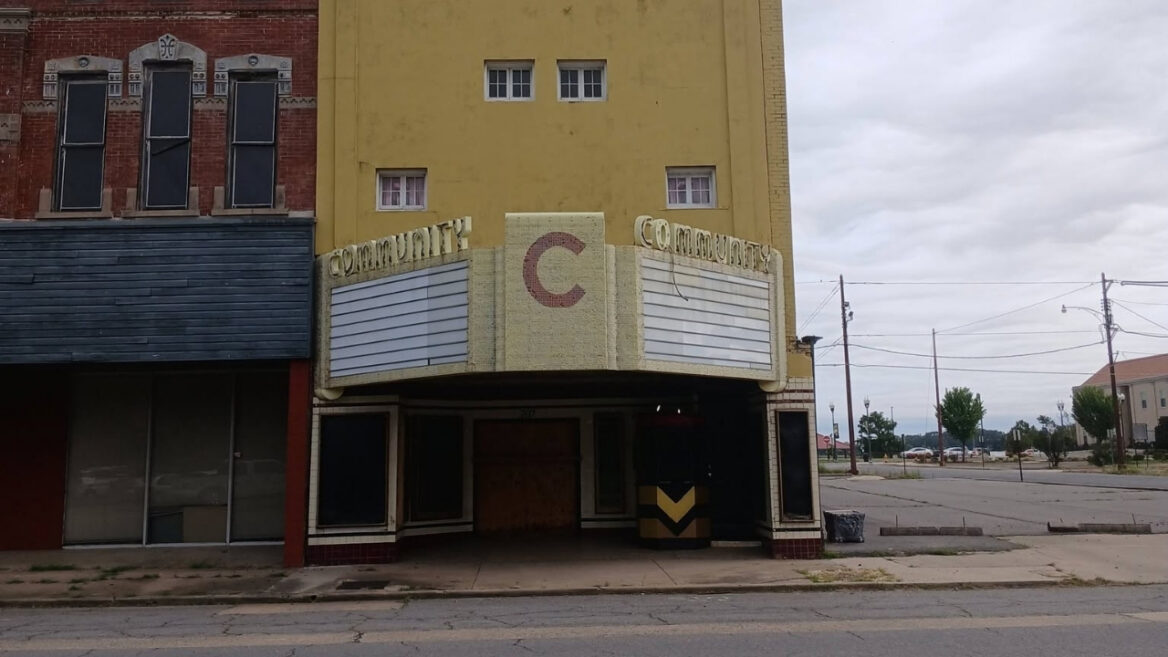
Jefferson County, Arkansas, is located just southeast of Little Rock. It’s about a 40-minute drive from the state capitol to the Jefferson County seat, Pine Bluff. Yet these two counties are a world apart. While Pulaski County is an urban center with approximately 400k residents, Jefferson County has a far more rural feel. The population in 2026 is estimated to be about 63k, which is a 19% drop from 2010, or nearly one fifth (5).
Since the 2008 financial crash, Jefferson County has been plagued by unemployment, seeing rates as high as 11%, both in the years following the ‘08 crash, and in the wake of Covid-19 (3). Today it still has some of the highest unemployment numbers in the state (2).
While the reasons that people move may be multifaceted, it is certainly the case that when a person cannot find work, he usually has to go somewhere that he can find work. So it is reasonable to assume that the lack of available jobs has contributed to Jefferson County’s steady population decline. In order to combat this problem, county officials asked voters to approve a dedicated ⅜-cent sales tax for “economic development,” to be administered by a public corporation, the EDCJC (the Economic Development Corporation of Jefferson County). The question was put to voters in a special election in February of 2011, and the tax was approved by a vote of 4,763 to 2,350 (14) – total voter turnout for this special election was just over 7,000. While this number may seem low, typical voter turnout in a November general election in Jefferson County is under 10,000. So, relatively speaking, it seems it was a representative sample of the usual voting county residents, who adopted the economic development tax in 2011 (25).
When the ⅜-cent “Pennies for Progress” tax reached its natural sunset in 2018, the EDCJC did not seek its renewal.
Why?
Well, the corporation’s chairman gave several reasons. He said that the EDCJC had ample assets on hand from the taxes collected already, that he saw no reason to “hoard” resources, and that perhaps the residents of Jefferson County should have a break from taxes (12). But wait!. These reasons seem to fly in the face of all expectations regarding government behavior.
So, what really happened? Let’s look at the record of “Economic Development” in Jefferson County from 2011 to 2018.
Over this seven-year period, the EDCJC funded ten “economic development” projects (6). Using publicly available information, these projects can be split into the following categories:
Category 1: Long-established existing Jefferson County Businesses
- Strong Manufacturing (est. 1950’s) (20)
- Kiswire Pine Bluff (est. 1990’s – Korean ownership) (26)
- Twin Rivers Paper (Mill est. 1960’s, acquired new ownership 2018) (27)
- L&R Distributors (took over existing distribution center from Walgreens) (32)
The businesses in this category were long-established in Jefferson County prior to the adoption of economic development taxes. They received some funding from the EDCJC and have not gone out of business. Therefore, the EDCJC counts these businesses as “wins.” In all, the EDCJC claims credit for “retaining” 410 jobs through the above projects. While job retention is a good thing, it’s difficult to prove causality – and retaining existing jobs is certainly a lower bar than attracting successful new businesses.
Of the four projects listed above, L&R is a standout for its positive performance – however, it is still the case that L&R took over a company and facilities that were already operational and performing well. L&R Distributors met its projected job numbers in 2019, the fact of which was treated with much fanfare by EDCJC (19). It has, according to the EDCJC, created a total of 200 permanent jobs in the county (6) and met all other obligations under the original economic development agreement. The company seems to be doing well. (Knowing government math as we do, one wonders whether these jobs were in addition (as one is led to believe) to those which existed just prior to the purchase of SAJ Distributors in 2012 or simply the retention of 200 permanent jobs, after a one year extension of its contract.)
Category 2: Failed or Never Started
- Horizon Foods → Summit Poultry (17, 28, 29, 30)
- GTL Americas / Energy Security Partners (gas-to-liquids) (7, 8, 9)
The two businesses above were supposed to provide 474 new jobs between them, but Horizon Foods went out of business only one year after receiving ED funds, and its successor, Summit Poultry, had no better success. The Gas-to-Liquids energy project – which was touted as the “largest economic development project in state history” at the time it was announced in 2016 – has failed to materialize ten years after receiving millions in funds from the EDCJC.
Category 3: Still Operating, But Underdelivered
- Vivione Biosciences LLC (34)
- Western Foods (gluten-free flour)
- Stacked Leasing (little public information available)
Vivione Biosciences was heralded optimistically as a venture which it was hoped might someday lead to 300 high-paying biotech jobs, but there is little evidence that they have more than the handful of employees with which they opened in 2012 (31); Western Foods is operational, with few employees, and very mixed reviews from truckers and employees alike; there is little information on Stacked Leasing, but its job claims are modest (~30), and they have not been touted by the EDCJC as having “met” project expectations.
None of the above three projects can exactly be pointed to as a resounding “economic development” success story.
Category 4: Still Operational, and Doing Well/Exceeded Expectations
- Highland Pellets (wood pellets)
Highland Pellets seems to be doing well. It is described as employing 120 people (18), which exceeds the number of jobs that were promised at the outset of the project. This project is the one standout success of the EDCJC.
The interesting thing about Highland Pellets is that its focus is on biofuels. Without going into the merits of burning trees for energy, we can note that biofuels are considered “renewable energy” by the US federal government – and indeed, in addition to over $500k in local incentives, Highland Pellets received $14.5 million in federal incentives (23). In other words – perhaps this “success” story would not be a success if the company were not double-dipping on government funds. In any case, it does appear that the company was created brand-new to take advantage of this particular financial environment (33).
On the whole, when the EDCJC reached its decision not to refer the economic development tax to voters for renewal in November of 2017 (12), it may be that they were simply too embarrassed by the seven-year record of their efforts and didn’t want to have to make a case to voters for the tax’s necessity.
Effects on Residents
Tax Increase: A ⅜-cent tax may not seem like much, but Arkansas already has the fourth highest average sales tax in America (35), and with the combined state and local rates, that ⅜-cent was enough to push some local rates above 10% in Jefferson County during the years in which it was active. While there isn’t much evidence of protests against the economic development tax itself, it is telling that the EDCJC chose not to seek renewal. Perhaps they already knew what those who later attempted to solicit tax increases in the county learned. The “Go Forward” tax (voted down twice, in 2023 and 2024) saw significant protests, with voters citing tax fatigue (13, 15).
And while we may not have a record of disgruntled residents complaining about the “Pennies for Progress” economic development tax, we do have data on population levels, median incomes, and home values – and that data tells a story.
Population: As noted in the opening, Jefferson County’s population has continued its steady decline (a roughly 19% drop from 2010 to the mid-2020s) (5). The “economic development” tax years show no clear slowing of the long-term population trend. Unemployment also does not seem to have been affected by the tax – employment trends track national shocks, such as the 2008 financial crash, and Covid-19 (3). Today – after the tax sunset, but with EDCJC activity ongoing with the residuals – unemployment in Jefferson County remains relatively elevated compared with the state and national average (2), though it is much lower than it was in the immediate aftermath of Covid.
It is difficult to say for certain how many jobs the EDCJC can realistically take credit for having created or retained, but whatever that number, it has not been detectable amid larger unemployment trends.
Median Income: But what about median income? Suppose the population did decline, and suppose unemployment wasn’t meaningfully affected – wouldn’t it be a win if it were at least the case that those who are working are now earning more?
The nominal picture of Jefferson County’s median income seems to show an increase, from about $28k in 1997 to $35k in 2010 (the pre-tax period). That income growth continued modestly to $38k in 2018 (the tax period) (36). However, if we zoom out and look at the picture of median income as a whole, what we see is that it tracks closely with inflation – and that in fact when we adjust for inflation, Jefferson County residents have lost purchasing power since the ‘90’s. That $28k in 1997 would have been worth $38k in 2010, $44k in 2018, and $55k in 2024. This means that in real terms, the median income, listed as $51k in 2024, has declined by 7%, and specifically that it declined 13% during the 2011-2018 economic development tax period, compared with the 1997 baseline.

Home Values: If we examine housing values in Jefferson County over that same period, the trend is almost the same (37): a roughly 13% decline in home values during the economic development tax period compared with the 1997 baseline, with values rebounding to nearly catch up with inflation in the present.
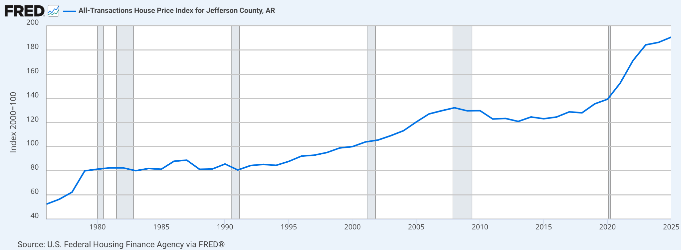
In short – while it is not conclusive that the “economic development” tax was to blame for depressing economic growth in Jefferson County from 2011 to 2018, it is also plausible that the tax did real measurable harm to the county’s economy overall. Of course, the overriding driver of economic prospects for Jefferson County’s residents is the US Federal Government – nothing the county does could compare with massive inflation, real estate bubbles, or Covid lockdowns. However, to the extent that a local tax-and-spend initiative can be seen to have had any effect – that effect was a negative one.
Conclusion
Of the ten economic development projects pursued by the EDCJC from 2011 to 2018, most either failed, never started, or under-delivered. The few “successes” were either long-established firms that received public money to retain existing jobs or a renewable-energy company that layered local incentives on top of large federal subsidies. The net result was no detectable improvement in the county’s overall economic trajectory – and a slight but measurable worsening of real median incomes and home values during the tax years themselves.
When a business is not already viable in the free market, simply handing it public money rarely fixes the underlying problems that made it nonviable in the first place: location disadvantages, weak management, insufficient market demand, or other structural barriers. The failed poultry plant, the never-built GTL facility, and the under-performing newer ventures illustrate this clearly. Highland Pellets shows that a business can be propped up outside pure market conditions – but only at the cost of tens of millions of dollars in combined local and federal subsidies.
The Jefferson County experience is a cautionary case study for any proposal (such as Issue 3) that would expand local governments’ ability to raise taxes and issue bonds in the name of “economic development.”
Concentrated benefits for a few firms, diffuse costs for residents, and measurable decline in the county’s overall health is the predictable pattern – not the exception which we may expect if Issue 3 is passed in Arkansas.
In retrospect, the EDCJC’s decision not to seek renewal of the economic development tax in 2018 looks like the most prudent choice it made.
Vote “NO” on Issue 3 in November 2026—to save our state!
*****
Sources and Further Reading
- 2025 article -says Jefferson County among highest unemployment (6.3%)
- JC unemployment – spikes to 11% after 2008 financial crash, gradually comes back down to 5% before 2020, spikes to 11% during Covid, corrects to 4% in 2023, now steadily climbing. Seems mostly unrelated to ED tax.
- Population, education, and employment stats from 2017 and 2021
- Estimated population statistics from 2025
- EDCJC website, listing projects and amounts awarded
- Describes projected $3.7 Billion capital investment project from 2016 as “largest economic development project in state history.”
- In-depth details on the GTL project, updates from 2018 (difficulty securing funding).
- Says the GTL plant is stalled 10 years into the project with the promised jobs not materializing. (March 2026)
- Current JC sales tax rates. If ⅜ cent is added countywide, the maximum was 10.125% with the ED tax.
- ED tax passed in a February special election.
- Source describes the board’s decision not to seek reapproval of the ⅜ cent tax in November 2017. Makris (chairman) said the ED fund already had $13 million, and they didn’t want to stockpile money.
- Source describes conflict over proposed “Go Forward” tax in 2024, with significant protests. Tax failed narrowly.
- Original passage of ED tax, notes vote totals (check for voter turnout).
- Summary of the “Go Forward” tax failure.
- Source says voters rejected the tax because there’s “not one completed building” in seven years. Another source noted officials saying “that’s not our fault because of Covid.”
- Source says Horizon Foods went out of business 1 year after setting up in Jefferson County.
- Highland pellets appears to be doing well (120 jobs per this article in 2026)
- L&R Distributors appears to be doing well (EDCJC touts their having fulfilled their obligations to create 200 jobs in 2019)
- Strong Manufacturing seems to be doing well – and they were a long-established company in Jefferson County.
- Article on the opening of Western Foods in Pine Bluff. Announced 2017.
- Another article on the opening of Western Foods (California based company).
- Article showing Highland Pellets also received $14.5 million in federal tax credits.
- Historic population numbers
- Voter turnout numbers for Jefferson County
- Kiswire Korean parent company
- Twin Rivers paper mill acquisition
- Summit Poultry acquiring Horizon Foods plant
- Summit Poultry payroll difficulties
- Tyson Foods reopened in Pine Bluff in 2021; Google maps shows Summit Poultry “permanently closed.”
- Vivione Biosciences opens, 11 employees.
- L&R takes over existing distribution center SAJ from Walgreens (2012).
- Source refers to Highland Pellets as a “brand new” facility opened by a group of investors.
- Vivione 300 job target number
- Current Arkansas tax rankings (incl. Sales tax rankings)
- Median household income
- Median home values