by Kristen Walker
The holidays are approaching, which for many Americans means travel. Airports are gearing up for the surge in traffic. Roughly 6 million people fly during the Thanksgiving holiday period, and another 52 million passengers during the winter holiday season. As folks prepare to feast with friends and family, spend time and money on a perfect gift, and attend obligatory holiday festivities, they also have to worry about buying plane tickets and navigating the hectic airport scene.
Airfares don’t come cheap, especially for those flying long distances. Prices are up nearly 25%from last year. The recent spikes in jet fuel are a contributing factor. But the government plays a part in inflating rates as well, both directly and indirectly.
Granted, the Deregulation Act of 1978 completely transformed flying for the better. By removing federal control over fares, routes, and market entry, it shifted the airline industry from a government-managed utility model to a competitive market system. Fares plummeted, new airlines formed, and routes expanded. Suddenly, millions more Americans could now access what was previously out of reach.
But the government still has a way of making airfares pricey.
Before deregulation, domestic ticket buyers encountered only one tax: an excise tax. Today, passengers additionally pay a September 11th security fee, facility charge, and flight segment fee. Some of these double with a layover. Passengers who leave the country face international departure and arrival taxes, customs and immigration fees, and even an animal and plant inspection fee. Depending on flight destination, taxes and fees constitute upwards of 20% or more of the total ticket sale.
Not itemized on a customer’s receipt, however, are government actions that negatively impact market forces and cause price increases. A prime example involves recent federal meddling in a potential airline merger.
Plagued by heavy financial losses and rising costs, fledgling Spirit Airlines decided to merge with JetBlue to gain financial stability and scale. By combining with JetBlue, Spirit hoped to plug into a larger network, share operational resources, and compete against the dominant “Big Four” (American, Delta, United, and Southwest). Washington blocked the merger, claiming that it would lead to fewer flights and price increases. But the intervention did not preserve competition; it removed it.
Unable to survive, Spirit filed for bankruptcy and eventually closed shop earlier this year, eliminating a major ultra-low-cost competitor that historically forced rival airlines to keep prices down. Other carriers feel less pressure to charge less, leaving consumers with higher prices and fewer choices. Average round-trip fares jumped 23%, or $60, when Spirit exited a route. Overall passenger volume fell 20%.
Lawmakers interfere with more than just mergers. US regulatory policy restricting foreign airlines from operating domestic flights prevents further competition. The European Union, known for cheap flights, maintains a legislative framework that forces traditional airlines and regional low-cost carriers to compete with their counterparts from other parts of Europe.
Flying is not only more expensive on account of government interference, but also a hassle. Getting through security checkpoints can be time-consuming, stressful, and inconvenient. Passengers face lengthy lines and strict regulations, waiting 15 to 30 minutes under normal circumstances or up to 45 minutes or more at peak travel times. Clothing removals, laptops in separate bins, and body scanners are nerve-racking. Having your luggage searched, if required, adds even more anxiety.
It’s a lot of trouble to be put through for a program that has historically demonstrated high failure rates.
The inconvenience is more profound with political standoffs in our nation’s capital. Government shutdowns force air traffic controllers and TSA workers to go unpaid, leading to staff shortages across the thousands of airports serving the US. Last fall’s 43-day shutdown resulted in $6.1 billion in total economic losses across travel and related sectors and 88,000 fewer domestic trips per day. Passengers endured longer wait times, tarmac delays, and canceled flights.
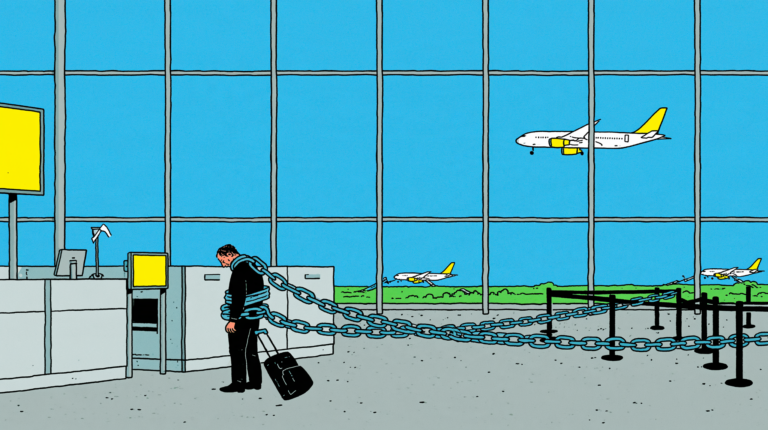
The massive airline deregulation nearly half a century ago may have revolutionized travel by driving down costs, expanding access, and fostering efficiency. But the government has kept its foot in the door, negatively impacting the flying experience for millions of customers through excessive taxation, harmful intervention, and cumbersome protocols.
Washington’s lingering grip on aviation keeps air travel more expensive and aggravating than necessary. If policymakers truly want to help travelers, they should stop adding friction to the market.
This article was originally published by the Foundation for Economic Education.