Arkansas policymakers have spent years building a sales pitch around economic development “wins.” Steel plants, food processors, billions in new investments, a state climbing the national rankings—and now the pitch is for “data centers.”
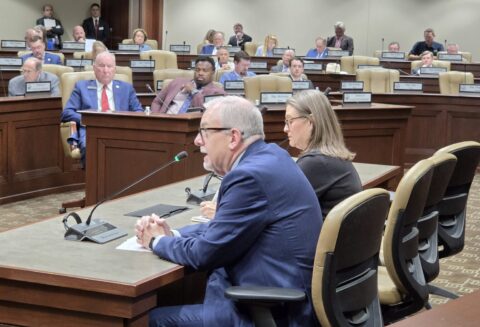
Director Clint O’Neal of the Arkansas Economic Development Commission delivered that pitch confidently this Spring at a May 20th Joint State Agencies Committee meeting in Jonesboro.
But when Rep. Jimmy Gazaway (R – Paragould) from HD31 pressed him on the return Arkansas communities may expect from data centers, O’Neal’s answer amounted to a candid admission: He really can’t be sure the math works!
O’Neal framed his sales pitch (and then what felt like backtrackingi) around what he called the three P’s of economic development: people, power, and property.
People: O’Neal acknowledged data center jobs “pay pretty well,” but the headcount is small compared to manufacturing — the kind of project that could put far more people to work on the same footprint.
Power: O’Neal raised the question himself of what a data center’s electricity demands mean for “your other opportunities that are coming in the future.” In other words, what is a community giving up in grid capacity by committing it to a data center? (00:51:24)
Property: O’Neal relayed a story from a national site selection consultant about a community in another state that handed over one of its best industrial sites — a large, rail-served parcel, several hundred acres — to a data center. O’Neal stated,
“That [industrial site] could have been used to attract several hundred good-paying jobs, and it was given to a data center. The job count is not going to be that large.”
His conclusion:
“[T]hat would not be worth it for a community to pay such a high opportunity cost to give away one of their largest and best industrial sites.” (00:50:35)
By O’Neal’s own framing, the primary benefit communities receive in return for granting tax incentives or tax cuts is an expectation of an overall net increase in property tax revenue. This expected increase in tax revenue is in spite of the fact that tax reductions for some actually mean tax increases for othersii. We mentioned in our earlier article that Arkansas law allows communities to abate up to 65% of property taxes for up to 30 years for these new companies/projects under Act 9 bonds.
O’Neal argues, “Even if you’re abating two-thirds, it’s kind of like attracting a billion-dollar project with no abatement,” he said, adding property taxes are “the primary benefit that communities are looking at.” (00:52:10)
If lawmakers are convinced that it is their job to offer tax incentives to bring new business to Arkansas (all in an attempt to keep up with other states—and call it, Economic Development), they should at least test the math against reality to find the best bang for the taxpayers’ buck.
Comparing what economic benefit data centers actually deliver to what other industries deliver on similar land and power, is the least that we should expect our legislators to discover before making decisions in this arena. And to do that, they need data.
State Rep. Wayne Long (R – Bradford) is on to that very point. He asked for exactly that: a side-by-side comparison of jobs per megawatt for a steel producer like Big River Steel, a manufacturer like Bad Boy Mowers, and an existing Arkansas data center.
“I always wondered if you could provide us maybe a ratio of jobs per megawattiii… so we can basically see how many jobs are we really getting on average per megawatt,” Long said. (00:59:58)
It’s a straightforward question, and a useful one. If data centers are going to be sold to communities as worth the tradeoff that O’Neal described, lawmakers and constituents alike deserve to see the numbers.
AEDC’s response: they’d try. “It may be a challenge just because we don’t always know the amount of power that some of those manufacturing facilities are actually using. But if we could get the information from the utility companies and we have job numbers, it’s something that we could work towards putting together.” [Emphasis added] (01:00:54)
In other words, the agency that administers data center tax incentives doesn’t currently have the comparative data needed to evaluate whether those incentives are the best deal — while its own director openly questions whether they are worth it. So, why are they still selling data centers to taxpayers?
And this begs the real question: Why are Arkansas legislators still passing laws that declare it their job to “create jobs” much less, jobs for those living out of state? Where, in our founding documents, do we find that economic development is the job of government?
Government does not create jobs! It is the government’s job to keep us safe so that we can enjoy life, liberty, and the pursuit of happiness. The best thing government can do is to stay out of the role of private enterprise and tax us less so that all Arkansas businesses have a better chance of success.
Call your friends and legislators and tell them to vote “NO” in November on Issue 3!
ICYMI: Read part 1 here.
To listen to the May 20 meeting in its entirety, click here.
i a/k/a covering your (a….) britches.
ii See Conduit article: Part 1 of 4 in Series on AEDC.
iii Asking for a way to compare taxpayer costs of the project to taxpayer benefit received from the project, then comparing same by industry.