In an interview with Conduit News, Fayetteville attorney Anita Schnee and voter and taxpayer Cecillee Duncan raised concerns about appointed boards, borrowing without constitutional limits, and a legislative process they say outpaced the study behind it.
With early voting weeks away and Election Day set for Nov. 3, two critics of Issue 3 say Arkansans are being asked to change their Constitution before anyone has settled how the change would work.
Issue 3 began in the 2025 legislative session as SJR15. It would allow economic development districts governed by appointed boards with the power to levy taxes and assessments and to borrow without constitutional limits, according to Cecillee Duncan, a voter, taxpayer, and senior health guide. [00:32:38]
The law meant to carry it out is still unsettled. That proposed enabling legislation was referred for interim study the day after SJR15 passed, she said.
“So what we’re being asked to do is essentially decide whether we should amend our constitution prior to the enabling legislation being studied,” Duncan said. [00:01:47]
How it reached the ballot
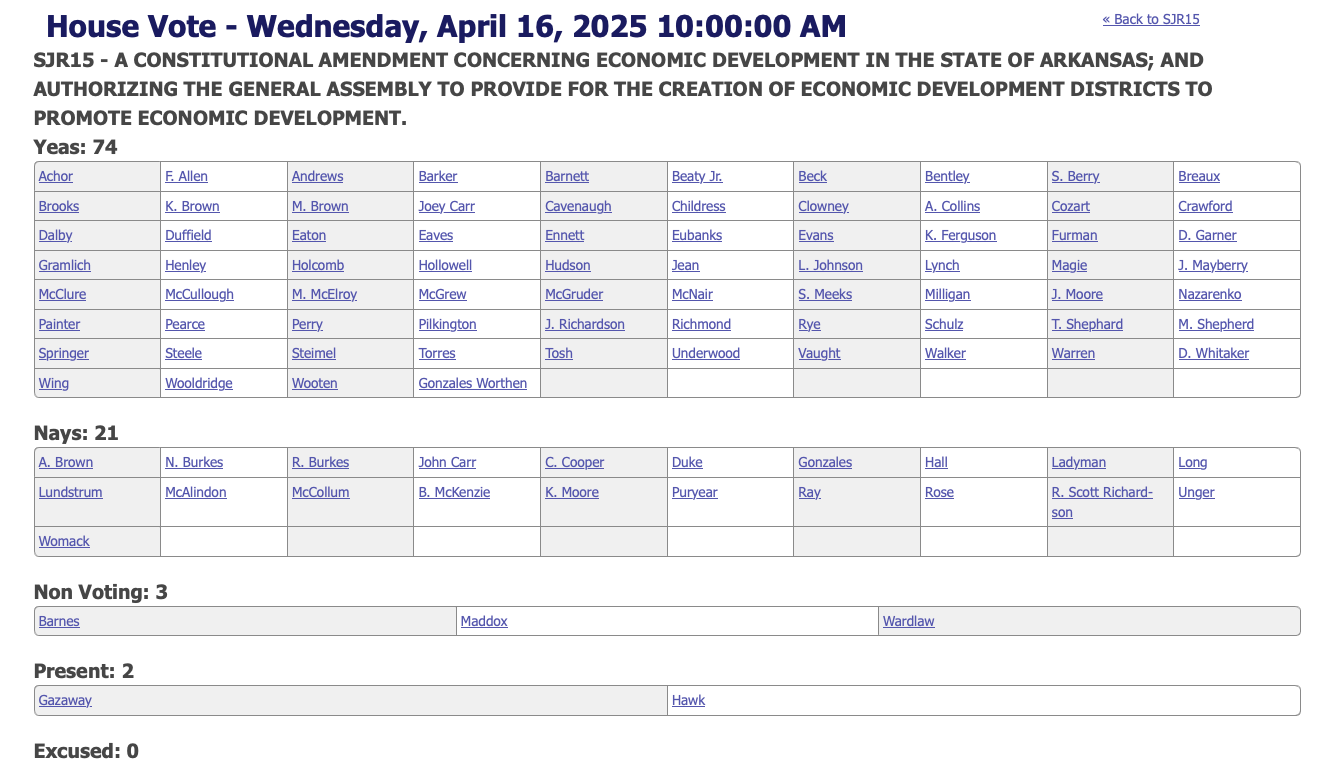
Duncan said the measure “definitely departed from the standard process.” Legislative rules were suspended five times on three dates — Feb. 11, March 12 and April 14 — to move it forward. [00:01:04]
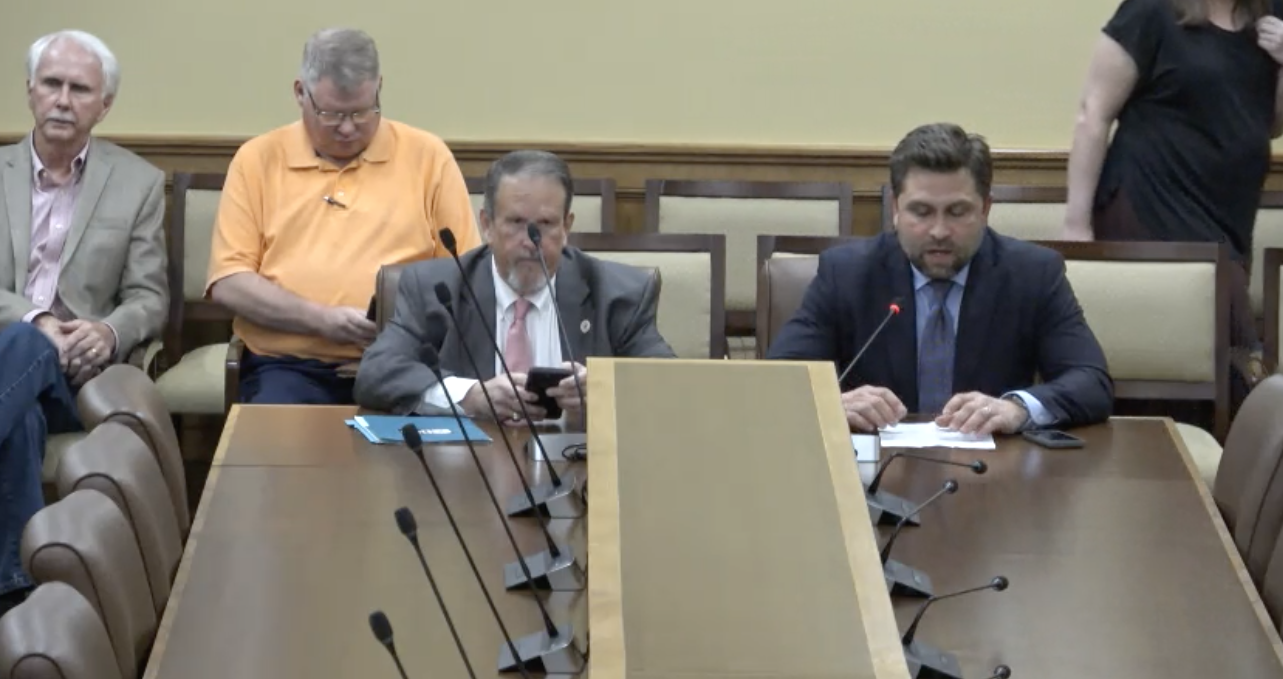
The enabling legislation came before the House State Agencies and Governmental Affairs Committee on April 15, the day after SJR15 passed, and was referred for interim study. [00:01:20]
After watching that hearing, Duncan said, “It really looked like there were a lot of questions left to be answered and a lot of ambiguity about just how it would function.” Lawmakers asked about changes in taxes, who would appoint the district boards, and how boundaries would be drawn. [00:02:19]
She questioned why the measure needed to be in the Constitution at all. “Constitutional amendments are the hardest to change,” she said. “And I think that something of this nature that grants such vast authority to an unelected board deserves scrutiny.” [00:04:22]
Anita Schnee, a Fayetteville attorney, said voters will see only the amendment on the ballot. The enabling legislation (SB647) is a separate document, and if the amendment passes, “the legislature could rightly interpret that to mean that they can then go forward with the enabling statute.” [00:05:17]
She described that bill as 31 single-spaced pages with hundreds of subsections. [00:05:32]
“That to me is really backwards,” Schnee said. “We’re being asked to approve something that we really don’t know what’s in it.” [00:05:46]
Local control questioned
Supporters of Issue 3 have framed the amendment as a tool that gives communities more control over their own development. Both guests disputed that.
Under the proposed enabling legislation, Duncan said, cities and counties would play a role in creating districts. But private landowners who own at least 25% of the property inside a proposed boundary could also start the process. [00:13:27]
“It gives an authority to one class of citizen that it doesn’t grant to another,” she said. [00:14:27]
The draft legislation also contemplates boundaries that are noncontiguous, meaning parcels “wouldn’t have to touch one another,” Duncan said. That could lead to parcels “being cherry picked by whomever might be interested in developing an economic development district.” [00:17:00]
Schnee said a property owner or company could apply to a city council or quorum court, which would have 90 days to approve or deny the request. “That’s not much time to do the kind of study and thought and local input,” she said. [00:09:44]
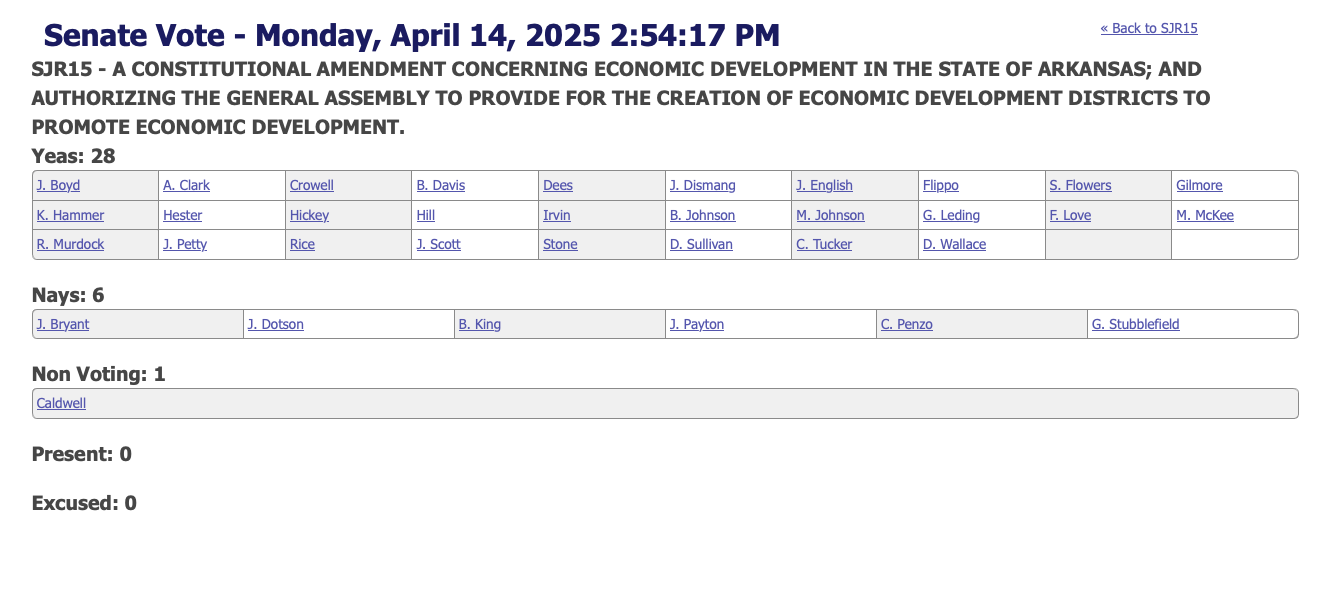
She said the amendment sets no standards a local body could use to turn down a project, leaving councils and quorum courts under pressure from both the deadline and the threat of lawsuits. [00:10:04]
“As an attorney, I can tell you that you just do not want to be passing legislation that will invite litigation,” Schnee said. “So local control is an illusion, at least as far as I can tell.” [00:10:40]
Asked whether the districts would override local zoning, such as Washington County’s planning and zoning ordinance, she answered, “Yes, that’s what I’m saying.” [00:08:34]
Who oversees the boards
During the interview, Conduit’s Ginny Lauren Dowden noted that SJR15 co-sponsor Rep. Howard Beaty told the House State Agencies Committee that the district boards would be appointed, and that members of a city council or quorum court could appoint themselves. [00:20:18]
Schnee said city councils and quorum courts are “responsive to voters,” but “Issue 3 hands the power over to these appointed boards.” Those boards could follow local zoning or bypass it, she said, and could approve subsidies, “meaning money would flow to corporations.” [00:21:40]
She said the amendment offers no clear way to unwind a district that isn’t working. “There’s no off ramp. We’re stuck with it,” she said. [00:22:27]
Schnee also disputed the argument that the Freedom of Information Act would allow the public to keep watch. “It is not available because it does not apply to private corporations,” she said. [00:22:27]
The Arkansas Department of Commerce, she said, “doesn’t have any authority. It has no enforcement power. It’s only there as guidance as far as I’ve been able to tell.” [00:26:11]
Borrowing and the taxpayer
The Arkansas Constitution currently places heavy restrictions on borrowing to subsidize industry, Schnee said. When a subsidized project fails, she said, bondholders still get paid. “It’s only a question of where does it come from? … If it doesn’t work, it comes from our tax base.” [00:11:25]
She pointed to the 1800s, when failed railroads and banks were bailed out by taxpayers, and the state was left “practically bankrupt.” [00:11:56]
“This is modernization that refuses to learn from history,” she said. [00:12:29]
Duncan said the proposed enabling legislation would not allow a failed district to declare bankruptcy, which would appear to leave taxpayers to cover the shortfall. [00:46:32]
She added that voters would approve district bonds only in a narrow case — when the bonds are repaid from ad valorem taxes. Bonds backed by other sources, such as federal grants, would need no voter approval. [00:47:11]
Schnee said she does not see how the districts would send new money back to local governments. “In fact, I see the reverse,” she said. [00:42:51] For roads, sheriff’s offices, fire departments and schools, “the math doesn’t add up.” [00:44:31]
The Texas argument
Sen. Dismang has argued Arkansas loses projects to Texas without tools like this, Dowden noted. [00:27:23] Duncan said she has “a great deal of empathy” for Arkansans in struggling parts of the state who see hope in the measure. [00:27:49]
“Just because other states have tried similar programs doesn’t mean that it’s a good idea,” she said. [00:28:17]
She cited the Meadows Metropolitan District in Colorado, which issued more than $30 million in bonds on a tax base that generated about $4 million a year. The interest grew to $118 million, she said. [00:28:47]
Issue 3, she said, “would allow an unlimited number of these economic development districts with borrowing authority that doesn’t have a constitutional limit.” [00:28:47]
Duncan noted that Texas has 10 times Arkansas’ population. “We are not Texas,” she said. [00:29:23] Her larger concern is that “Arkansas is going to end up competing with itself,” with communities offering more and more in what could become “a race to the bottom.” [00:30:12]
Campaign materials say 48 other states have this kind of tool. Duncan said 33 states have “pretty robust accountability measures,” while 17 do not. “Arkansas is one of those states that has really no accountability measures, no feasibility studies, and no way to hold a company responsible,” she said. [00:37:26]
Schnee said many of those states acted by statute, which lawmakers can adjust “relatively easily” when something doesn’t work. “You cannot do that with a constitutional amendment,” she said. [00:40:29]
Duncan also pointed to the amendment’s “very broad repeal clause,” under which any conflicting statute or constitutional provision would give way. [00:39:38]
A message for voters
Asked why lawmakers pursued a constitutional amendment rather than a bill, Schnee said, “I think it’s because they really want to go in like gangbusters.” [00:41:32]
“It’s important that the voters send the legislature a message that if they want to be doing things like this, they had better study it more carefully and they better explain it to us,” she said. “Because I’m a lawyer and I had great difficulty wading through it all.” [00:49:39]
Duncan framed it as a question for voters: “Do you want an unelected board with broad authority to tax you, levy assessments on you, and without constitutional limits on their borrowing?” [00:50:14]
For those who want to read further, she recommended the U of A’s voter information page and the committee hearing videos on the state’s website, searching SB647 and SJR15. “You’ll see even our lawmakers struggle with a lot of the questions,” she said. [00:51:16]
Duncan, whose family has been in Arkansas for four generations, said she hopes Arkansans will talk with one another and “figure out what economic development tools do work for our state.” [00:53:44]