
Issue 3 on this November ballot (Early Voting already underway) proposes to create “Economic Development Districts” for the stated purpose of using tax incentives and bonds to attract and retain commercial enterprises in said districts. Proponents of Issue 3 argue that Arkansas needs such “tools” if it is to compete economically with its geographical neighbor, Texas.
Arkansas vs Texas:
Arkansas is not Texas. Texas has five times the land area of Arkansas (1). It has ten times Arkansas’s population (1), and fifteen times our annual GDP (2). Texas’s $2.29 trillion in annual GDP is the second highest in America, while Arkansas’s comparatively modest $150 billion ranks around 36th. In terms of overall state tax burden, Arkansas ranks as the 26th highest, while Texas comes in 36th (3). Arkansas’s most populous city – Little Rock (4) – is smaller than Texas’s 16th largest city – Grand Prairie (5). In terms of land, people, energy, and infrastructure, Arkansas is simply physically dwarfed by its larger neighbor.
Perhaps the argument could end there: expecting Arkansas to compete head-to-head with Texas is a bit like asking a six-inch sapling to produce as many acorns as a forty-foot mature tree, or like asking a canoe with an outboard motor to haul the same cargo as an aircraft carrier. The two things are not apples-to-apples, and cannot realistically be compared.
Proponents point to Texarkana as a place where direct comparison is possible. They claim the Texas side outperforms the Arkansas side because of local Chapter 380 tools. That claim rests on three assumptions: that the Texas side is clearly doing better, that local incentives are the reason, and that Issue 3’s districts are comparable to those tools. Each assumption is worth examining.
Is Texarkana, Texas, doing better than Texarkana, Arkansas?
Census data show residents on both sides of the state line have similar economic circumstances (6):
| US Census 2025 | Texarkana TX | Texarkana AR |
| Population | 36,195 | 29,123 |
| % Children | 24.8% | 23.5% |
| Home Ownership | 51.6% | 54.7% |
| Home Value | $171,500 | $170,200 |
| Labor Force | 56.4% | 54.6% |
| Per Capita Income | $30,284 | $28,462 |
| Poverty Rate | 22% | 25.8% |
| Avg Commute | 14.7 minutes | 17.1 minutes |
| Sales per capita | $52,655 | $15,500 |
Household metrics are close. The clear difference is commercial activity: sales volume is far higher on the Texas side, reflecting more businesses. Residents of both sides benefit from businesses located anywhere in the metro area. However, it is worth examining why this discrepancy exists: is that commercial difference driven primarily by local, targeted incentives (as Issue 3 proponents claim (17))? Or by the permanent statewide business environment?
State Taxes and the Hierarchy of Federal, State, and Local Policy
Texas has no corporate income tax. Arkansas taxes corporate income at 4.3% (7). That single difference is a straightforward, statewide advantage for any business deciding where to locate or expand inside the Texarkana area. If the goal is to make the Arkansas side more competitive, eliminating or reducing the corporate income tax (or the inventory tax) would apply the same lower cost to every business rather than only to those that negotiate a special deal.
Broader evidence supports treating statewide tax structure as more consequential than local incentives. In terms of magnitude of effect, Federal policy/events have the greatest effect, followed by state policies, with local programs a distant third.
Consider these unemployment graphs from a handful of randomly selected counties from around the US:
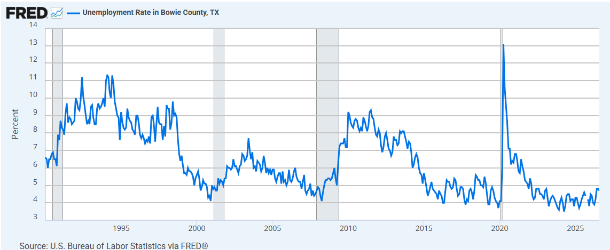

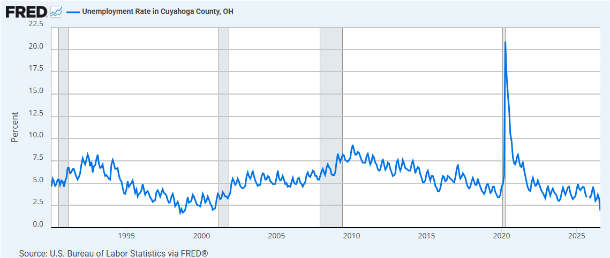


Unemployment rates in counties across the country move together with national events – the 2008 financial crisis and the 2020 COVID period produce clear spikes everywhere. Federal cycles dominate local outcomes.
State policy is the next layer. States without income taxes have shown stronger private-sector job growth once national trends are accounted for (9)(10). Local incentive programs rank a distant third; their net effects are hard to isolate and often smaller than claimed (11)(12).
Texarkana, Texas has used various local “economic development tools” for decades (Chapter 380 agreements, TIRZs, abatements). Public data on the results of these efforts is severely limited, making an assessment of their “success” impractical. But what is measurable is the overall tax burden: even with the Arkansas-side exemption from state income tax (14), the total tax burden on the Arkansas side of Texarkana is 26.1% higher than on the Texas side (13).
How is this possible?
It’s possible because – as it turns out – all of Texas’s “tools” for attracting businesses are in fact the same: lower taxes.
Texas’s “Economic Development Toolbox” versus Arkansas’s Issue 3
We’ve already discussed the baseline lower taxes in Texas due to the absence of personal and corporate income taxes. But in addition to this, the “tools” available in Texas’s Chapter 380 “toolbox” consist almost entirely of the ability to offer yet lower taxes, on an individual basis (15). Some localities in Texas do levy additional sales taxes for “Economic Development” purposes, but these must be approved by local ballot measure, and (critically) are administered by existing elected governments, subject to all of the established oversights and checks that you would expect.
This is very different from what is proposed by Arkansas’s Issue 3 (16). Issue 3 would authorize districts that function as independent entities with the power to levy taxes or assessments and issue bonds outside ordinary constitutional debt limits. Property inside a district could be exempted from city, county, and school taxes and instead pay taxes to an appointed board, which would set the tax rate. Operating rules, oversight, and accountability would be left largely to later legislation. The practical result is new micro-governments that can direct public resources to selected private projects with limited definite constraints.
Conclusion
Arkansas will never be Texas. It will never be as large or populous, and it will never have the same natural resources. However, if Arkansas wants to compete with Texas in terms of business friendly policy, it has two options:
It could reduce taxes for everyone across the board as Texas has done. This is a highly reliable method for attracting both businesses and the populations that support them. OR-
It could propose “tools” to reduce taxes on a case-by-case basis as Texas does at the local level. This is far less fair, far more socialist, and far less effective than the first option- but it is at least giving localities the “same” tools that are available in Texas.
What Arkansas should not do is create independent micro-governments with the ability to govern at their whim without limitation. Businesses respond to stable, favorable environments. Extreme instability and uncertainty is repellant to businesses, and that is what you would get with Issue 3.
ICYMI: False Starts – The Story of “Economic Development” in Jefferson County, Arkansas
“Economic Development:” Two Words That Settle Nothing
The Rich Get Richer: Issue 3 and the Reverse-Robin-Hood Effect
Act 576: The Government Power Grab You Weren’t Supposed to Notice
Op-Ed: We Won the Steel. Now We Have to Win the People
Mississippi County, Arkansas: A Case Study in “Economic Development” Districts
Sources