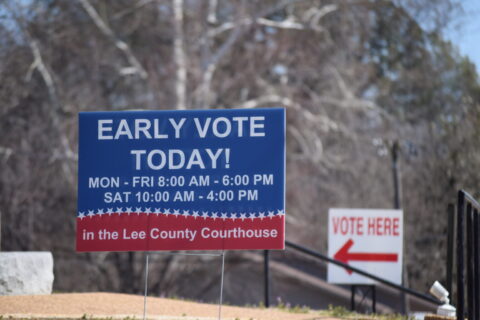
Washington County voting data has raised questions among some Republican circles decrying “low voter turnout.” While this may be a convenient excuse to some for a loss here or there, a suggestion that “disunity among a small number of faithful party members has kept voters from the polls” is hardly a good excuse for a loss.
Those promoting this excuse suggest their own Republican candidates underperformed because divisions within the party discouraged voters from showing up. A closer look at the numbers suggests that explanation may just be that—an excuse offered for convenience.
Upon review of the voting data for Washington County over the past decade shows that turnout in the 2026 Republican primary was largely in line with what the county typically sees in similar elections, if not greater than usual. These facts point to a broader lesson that applies well beyond Washington County—
To understand election turnout, you must first understand your county and the contests involved within each party’s primary.
In the March 2026 Washington County primary, 34,947 voters cast ballots out of 148,228 registered voters, for a turnout rate of 23.6 percent.
That number may seem low to some. But context matters.
In 2022 (a like year with no Presidential election but elections to statewide offices) many more individual Republican office holders had contested races statewide. In that year, Washington County turnout was only 21.4 percent — actually lower than in 2026.
In 2018, turnout was even lower at 13.9 percent.
The years with the highest participation in the data set — 2016 and 2020 — were Presidential election cycles, when turnout is historically much higher across the country. So, comparing a non-Presidential primary like 2026 to a Presidential election year, doesn’t provide a clear picture.
Another pattern in the data is that turnout rises and falls based largely on how many races voters believe are worth their effort. All races are not created equal, just as the excitement for all candidates is not the same. When there are multiple contested races, with dynamic candidates or many dollars at stake, participation increases, indicating—it is truly a numbers and money game. Thus, when there are fewer competitive races, fewer dollars are spent to get out the vote, and the turnout drops.
The 2022 primary featured numerous contested races across the state. By contrast, 2026 had far fewer competitive primaries overall, which naturally lowers voter participation. This dynamic applies in every county. And voters show up when they believe their vote matters in a specific race or candidate contest.
The 2026 primary numbers also illustrate how closely divided Washington County may be politically, meaning Republican v Democrat. For this year the numbers breakdown as follows:
Republican ballots: 17,145 (49.1%)
Democratic ballots: 16,070 (46.0%)
Non-partisan ballots: 1,732 (4.9%)
That kind of split suggests party outcomes in Washington County often depend less on broad party trends and more on how many contested races in the respective party primary and the specific candidates from which voters are asked to choose. For a more precise high-level view of potential total party votes, the general election results are often more useful than primary turnout.
Another factor shaping the voter turnout numbers is population growth. Washington County has seen its voter rolls grow from 120,081 registered voters in 2016 to 148,228 in 2026 — an increase of more than 28,000 voters or more than 23% in a decade.
That kind of growth is common in Northwest Arkansas, while other counties across the state may see little change or even declines in voter registration.
Conclusions. An actual review of the Washington County data highlights several lessons that may apply across Arkansas.
By their nature, primary elections include a host of different scenarios which will affect turnout. Those include:
- Primary turnout in either party depends heavily on the number of contested races within that specific party and the level of voter interest in each particular race. When party ballots lack competitive contests, overall party participation drops.
- Runoff elections almost always produce dramatically lower turnout. The campaign most success at identifying and mobilizing their voters usually wins.
- General election turnout numbers often provide a better perspective of whether a county tends to lean Republican or Democratic, since voters from both parties participate in the same race. But then again, a dynamic candidate related to the issues of the day may garner a larger turnout.
- When comparing election statistics from year to year, it is important to compare apples to apples and make sure you compare similar election cycles. For example, Presidential election years should generally be compared with other Presidential election years. But even then, when looking only at primary turnout, the level of competition within each individual party’s primary matters. A highly contested Presidential primary such as the 2016 Republican primary with five significant candidates yielded 29K votes, while the Democrat primary that year with only two significant candidates yielded 17.9K votes. The 2016 election looks very different from a Presidential primary where the nominee is largely uncontested such as the 2020 Republican Primary yielding a 13.8K turnout to a Democrat turnout of 24.5K And then the actual candidates become a big factor when comparing the 2024 Primaries with the Democrats turning out only 6.76K voters to a Republican turnout of 18.6K.
- Finally, voter populations change over time, and those changes vary from county to county. Northwest Arkansas continues to grow rapidly, while other areas of the state may see different trends.
Taken together, the Washington County numbers suggest that turnout in the 2026 primary falls well within the normal range for comparable elections or maybe producing even a greater turnout than should have been expected.
Before drawing sweeping conclusions about turnout or party dynamics, it helps to first understand the basic patterns in each county’s elections.
In other words, the first rule of election primary analysis may simply be: Know Your County and Know Your Races.